Fluidic Systems metering and mixing machines are widely used in the Aerospace Industry for their accuracy in processing adhesive/sealants and coatings. This white paper compares...
In the 2025/2026 season, the UniNa Corse racing team from Federico II University of Naples took on the ambitious challenge of designing, building, and racing a fully electric...
The potential of microrobots is enormous. These miniature objects can be designed to carry out actions within the body, such as sensing biomarkers, manipulating...
With its opposable thumb, multiple joints, and gripping skin, human hands are often considered to be the pinnacle of dexterity, and many robotic hands are designed in their image. But...
A new artificial intelligence control system enables soft robotic arms to learn a wide repertoire of motions and tasks once, then adjust to new scenarios on the fly, without...
Manufacturers of medical devices and surgical instruments face strict demands for safety, hygiene, and regulatory compliance. Machining processes leave...
Microscopes are essential for precise 2D and 3D visualization and measurement in quality control, failure analysis, and R&D. Choosing the right setup requires...
An innovative 3D printing process that advanced NASA’s approach to outfitting a lunar habitat is making buildings on Earth beautiful, efficient, and strong.
WattAnyWhere’s pollutant-free fuel cell generator converts renewable ethanol into clean electricity, offering businesses and communities a sustainable alternative to traditional grid-based power.
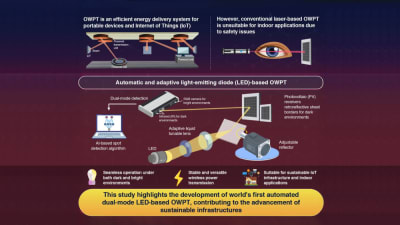
The world’s first automatic and adaptive, dual-mode light-emitting diode (LED)-based optical wireless power transmission system, that operates seamlessly under both dark and bright...
In a first-of-its-kind test, engineers at the University of California San Diego are experimenting with large, mobile batteries to both charge electric...
Our society's rapid pace of technological advancement is accompanied by an equally rapid growth in power consumption to meet our needs for AI-focused data...
In a cooperative project, Empa researchers investigated inductive charging of electric cars. This is not only similarly efficient to cable-based charging but could also simplify the integration...
Last December, Tech Briefs readers were asked to select one product from our 2025 Products of the Month to be named Readers’ Choice Product of the Year. Thanks to all of our readers who cast their votes. Read on for the three 2025 winners.
See the products of tomorrow, including a bio-mimetic, light-powered soft lens that mimics the human eye’s ability to refocus and adjust to varying light conditions; a new material for insulating windows that could improve the energy efficiency of buildings worldwide; and more.
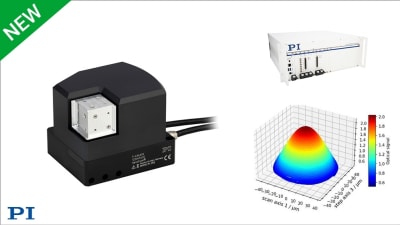
See what's new on the market, including Aerotech's PICAlignTM architecture, a new active alignment solution designed to overcome the manufacturing challenges of high-volume Co-Packaged Optics (CPO) production; PI's 6-axis piezo alignment platform: the P-616.65S Nano-Cube® 6-DOF piezo-flexure nano positioning system; a high-impedance miniaturized ferrite-core wire wound inductor from Coilcraft; and more.
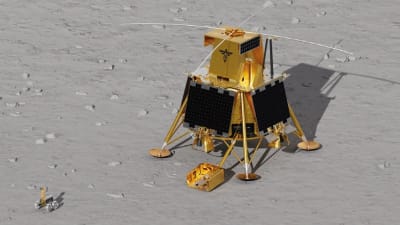
Firefly Aerospace recently announced a new commercial payload agreement with Volta Space Technologies to host a wireless power receiver on Firefly’s Blue Ghost Mission 2 lander on the far side of the Moon. The payload will serve as a technology demonstration for Volta’s planned lunar power network, called LightGrid. Read on to learn more.
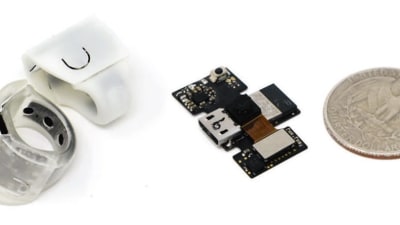
University of Washington researchers have developed IRIS, a smart ring that allows users to control smart devices by aiming the ring’s small camera at the device and clicking a built-in button. The prototype Bluetooth ring sends an image of the selected device to the user’s phone, which controls the device. Read on to learn more.
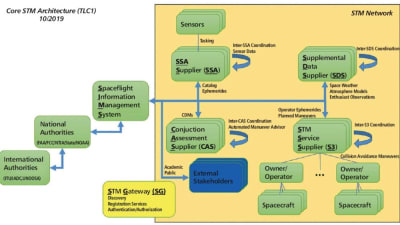
Space is becoming increasingly congested due to rising numbers of on-orbit satellites and debris objects. Uncontrolled growth will severely affect future space operations. NASA Ames has developed a novel patent-pending technology known as Space Traffic Management (STM) which provides a robust framework for on-orbit coordination of activities to enhance the safety, stability, and sustainability of operations in the space environment. Read on to learn more.
Imagine simply telling your vehicle, “I’m in a hurry,” and it automatically takes you on the most efficient route to where you need to be. Purdue University engineers have found that an autonomous vehicle (AV) can do this with the help of ChatGPT or other chatbots made possible by artificial intelligence algorithms called large language models. Read on to learn more.
Researchers at McGill University have made a major breakthrough in advancing all-solid-state lithium batteries, a promising next-generation technology for electric vehicle (EV) batteries. By addressing a long-standing issue with battery performance, this innovation could pave the way for safer, longer-lasting EVs. Read on to learn more.
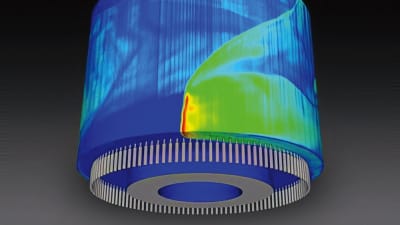
In a new collaboration, the Argonne National Laboratory and National Energy Technology Laboratory are leveraging their expertise in RDEs to develop advanced computational fluid dynamics tools that can give scientists a deeper understanding of the combustion process to unlock more of the engine's potential. Read on to learn more.
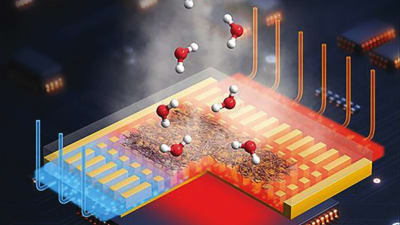
Engineers at the University of California San Diego have developed a new cooling technology that could significantly improve the energy efficiency of data centers and high-powered electronics. The technology features a specially engineered fiber membrane that passively removes heat through evaporation. It offers a promising alternative to traditional cooling systems like fans, heat sinks and liquid pumps. Read on to learn more.
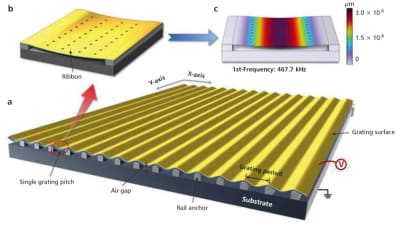
A new Microelectromechanical system (MEMS) grating modulator has been developed, offering significant advancements in optical efficiency and scalability for communication systems. By integrating a tunable sinusoidal grating with broadside-constrained continuous ribbons, a large-scale aperture of 30 × 30 mm is achieved and supports high-speed modulation up to 250 kHz. Read on to learn more.
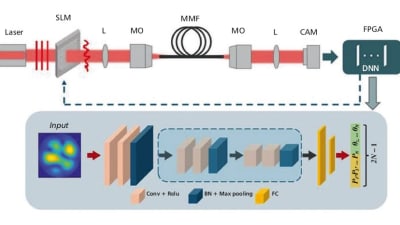
The technique promises immediate impact not only on high-capacity optical communications but also on real-time endoscopic imaging, vibration-tolerant fiber sensors, and any application that demands fast, energyefficient phase retrieval. Read on to learn more.



 Blog: Software
 Blog: Lighting
 Blog: Energy
 INSIDER: Energy
 News: Energy
 Blog: Aerospace